# `r/moul/vesting`
How much of a gno.land account's balance can **actually move right now**.
## Read this before trusting a number here
A realm cannot read an account's vesting schedule. `banker.GetCoins` returns the **total**
balance with the locked part included, and no native exposes `std.VestingSchedule`. So the
page reads two things from the chain and is told the third:
| figure | source | trust |
|---|---|---|
| balance | `banker.GetCoins`, every render | always true |
| the clock | the block time, every render | always true |
| the schedule | supplied, see below | only as good as its source |
Every rendered figure says which of the two it rests on. Nothing is presented as verified
when it is not. That honesty is the feature: a page that quietly guessed the locked amount
would be worse than no page.
## Where a schedule comes from
**The URL**, for a one-off that stores nothing:
```
/r/moul/vesting/v0:g1youraddress?o=106560000000&s=1789225200&e=1852383600
```
`o` original vesting in ugnot, `s` start, `e` end, both unix seconds, `&d=1` for a `delayed`
schedule. Read your real one off the chain:
```sh
gnokey query auth/accounts/g1youraddress -remote https://rpc.gno.land:443
```
**Or the registry.** `Declare` writes a schedule for the **caller's own address and no
other**. That is the whole trust model: an address can only misdescribe itself, and a wrong
entry misleads nobody but its author. `Forget` takes it off again.
## Why a cached schedule is honest rather than stale
Because a schedule can never change. `std.SetVesting` has exactly one caller in the
monorepo, `gno.land/pkg/gnoland/app.go`, during genesis balance loading, and no message type
creates or modifies one. A schedule declared correctly today is correct forever.
## Routes
| | |
|---|---|
| `/r/moul/vesting/v0` | every schedule on file |
| `…:g1…` | one address |
| `…:g1…?o=&s=&e=` | one address, with a schedule you supply |
## Notes
The seeded schedules are source constants, not registry rows. This realm is
`private = true`, so a redeploy wipes realm state, and the one schedule the page exists to
show should not need a transaction to come back. A seeded address is refused by `Declare`
for the same reason: a redeploy would silently revert whatever it set.
The arithmetic is [`p/moul/vesting`](/p/moul/vesting/v0), which mirrors what the chain
enforces, down to the rounding direction.
<!-- BEGIN GNOCONTRACTS FOOTER (generated by `make readmes`; do not edit below) -->
---
Part of **[moul/gno-contracts](https://github.com/moul/gno-contracts)** — moul's versioned gno.land contracts. See the repository for the full catalog, build/test tooling, and usage.
**Dependency graph:**
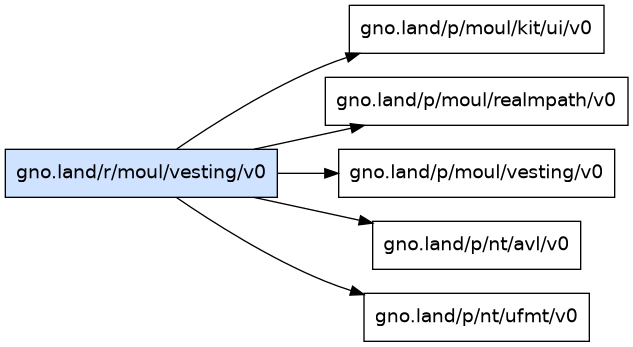
> ⚠️ **Disclaimer:** provided as-is, without warranty; not security-audited. Full disclaimer: [DISCLAIMER](https://github.com/moul/gno-contracts/blob/main/DISCLAIMER.md).
<!-- END GNOCONTRACTS FOOTER -->
Count() int
Declare(cur interface {.seal func(); Address func() .uverse.address; IsCode func() bool; IsCurrent func() bool; IsEphemeral func() bool; IsUser func() bool; IsUserCall func() bool; IsUserRun func() bool; PkgPath func() string; Previous func() .uverse.realm; String func() string; Sub func(string) .uverse.realm; Subpath func() string}, original int64, start int64, end int64, delayed bool)
Forget(cur interface {.seal func(); Address func() .uverse.address; IsCode func() bool; IsCurrent func() bool; IsEphemeral func() bool; IsUser func() bool; IsUserCall func() bool; IsUserRun func() bool; PkgPath func() string; Previous func() .uverse.realm; String func() string; Sub func(string) .uverse.realm; Subpath func() string})
LockedOf(addr string) (locked int64, ok bool)
Render(path string) string
ScheduleOf(addr string) (original int64, start int64, end int64, delayed bool, ok bool)
SpendableOf(addr string) (spendable int64, ok bool)
Signatures reconstructed verbatim from vm/qfuncs — interface params keep their inline definitions.
vm/qrender output, sanitized (docs/render-security.md) and displayed in an empty-sandbox iframe — scripts, forms and popups cannot run. Links stay inert in-preview; right-click to open.